The Liver Life Project
Alcohol-Induced Cancer
Alcohol
is
a
group
1
carcinogen,
which
means
that
there
is
enough
evidence
to
show
that
alcohol
causes
cancer.
Other
group
1
carcinogens
include
UV
radiation
and
tobacco
smoke.
Alcohol
causes
3.3%
of
cancer
cases
in
the
UK,
which
is
around
11,900
cases
per
year.
To
put
this
in
context, tobacco smoking causes 15% of cancer cases in the UK.
The
evidence
shows
that
any
amount
of
alcohol
can
increase
the
risk
of
cancer,
but
drinking
14
units
a
week
or
less
will
keep
the
risk
low.
Evidence
shows
that
any
amount
of
alcohol
can
increase
the
risk
of
cancer,
but
drinking
14
units
a
week
or less will keep
this risk low.
For
some
cancers,
any
amount
of
alcohol
increases
the
risk.
For
other
types
of
cancer,
the
risk
only
increases
after
drinking
two
or
three
drinks
per
day
–
around
26
to
35
units
per week.
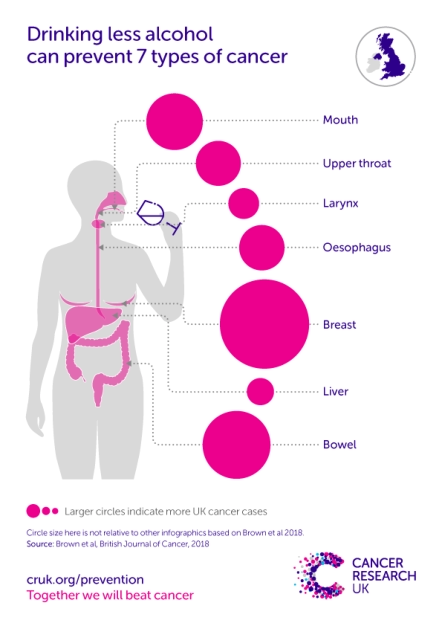
Any amount of alcohol increases the risk of:
Mouth cancer
Upper throat and voice box cancer
Food pipe (oesophagus) cancer
Breast cancer
Drinking two or more drinks per day (around 3.5 units) increases the risk of:
Colorectal cancer
Drinking three or more drinks per day (around five units) increases the risk of:
Stomach cancer
Liver cancer
Alcohol
increases
the
risk
of
these
cancers
by
different
amounts.
If
you
were
drinking
every
day,
every
10
grams
of
pure
alcohol
(around
one
drink or 1.25 units) would increase the risk of these cancers by the following amounts, compared to if you were not drinking:
Mouth and throat cancer by around 15%
Oesophagus cancer by 25%
Breast cancer by 7%
Colorectal cancer by 7%
Liver cancer by 4%
Stomach cancer by 2%
To
put
these
figures
into
context,
a
woman
drinking
between
14
and
35
units
per
week
has
a
15%
chance
of
developing
breast
cancer,
compared
to
an
11%
chance
if
she
didn’t
drink
at
all.
Similarly,
a
man
drinking
up
to
14
units
per
week
has
a
0.6%
chance
of
developing
colorectal cancer, which rises to an 11% chance if he drinks over 35 units per week.
Alcohol causes around 11,900 cases of cancer per year in the UK.


Nearly 500 North East adults a year dying from cancers due to alcohol
Back
in
2023,
a
campaign
by
Balance
called
“Alcohol
is
Toxic”
was
launched.
This
was
supported
by
Cancer
Research
UK
and
local
authorities
to
warn
that
alcohol
is
a
direct
cause
of
7
types
of
cancer
–
including
bowel,
breast,
liver,
throat
and
mouth cancer.
Only
1
in
3
people
in
the
North
East
are
aware
that
alcohol
causes
cancer,
and
yet
nearly
half
(47%)
of
adults
are
drinking
above
the
Chief
Medical
Officers’
guidelines
of
no
more
than
14 units a week – enough to significantly raise their risks.
It
also
comes
as
the
UK
topped
global
charts
for
binge
drinking
among women
– defined as having at least six drinks in a single session – with 26% doing this at least once a month.
This
powerful
new
creative
from
Balance
is
unlike
any
campaign
ever
seen
before
for
alcohol
in
the
UK
and
follows
the
journey
of
alcohol
through
the
body,
mutating
cells
and
leading
to
the
formation
of
a
tumour.
It
has
been
developed
with
input
from
doctors
to
depict
the
evidence
on how alcohol causes cancer.
People
are
being
encouraged
to
visit
the
ReduceMyRisk.tv
website
to
find
free
advice
and
tools to cut down and, links to local alcohol support services.
Latest figures around alcohol and cancer reveal:
Nearly 500 deaths (483) from cancer as a result of alcohol in 2019 in the North East.
Up
to
1,640
men
every
two
years
diagnosed
with
an
alcohol-related
cancer
in
the
North
East.
The
most
common
cancer
in
men
with
known
associations
with
alcohol
is
bowel cancer.
Up
to
1,580
women
every
two
years
diagnosed
with
an
alcohol-related
cancer
in
the
North
East.
The
most
common
cancer
for
women
with
known
associations
with
alcohol is breast cancer.
Alcohol
is
estimated
to
have
caused
around
740,000
new
cases
of
cancer
a
year
globally and 17,000 in the UK in 2020
The
World
Health
Organisation
warns
there
is
“no
safe
amount”
of
alcohol
for
health,
with
the risks starting from the first drop.